
In This Article
Let me tell you something – I’ve tested dozens of cooling units over the years, and there’s nothing quite like the sweet relief of a properly sized portable air conditioner 14000 BTU unit on a sweltering summer day. These powerful machines aren’t your typical wimpy desk fans masquerading as climate control. We’re talking serious cooling muscle here.
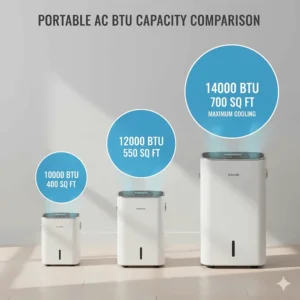
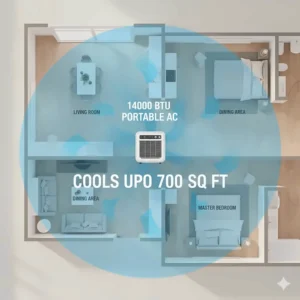
A portable air conditioner 14000 BTU packs enough punch to cool spaces up to 700 square feet, making it perfect for master bedrooms, large living rooms, home offices, or even open-concept spaces. According to the U.S. Department of Energy, portable air conditioners in this range represent the upper tier of residential cooling capacity, delivering approximately 20 BTU per square foot – the sweet spot for efficient temperature management.
What makes 14000 BTU units special? Unlike their 10000 or 12000 BTU cousins, these high BTU portable AC units offer maximum cooling area coverage without requiring permanent installation. You get the cooling power of a window unit with the flexibility of a portable system. No contractor needed, no landlord permission required, just plug-and-play comfort.
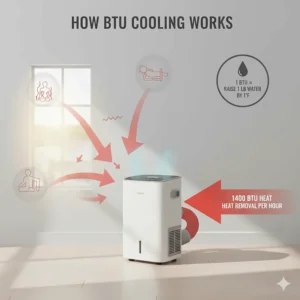
The science is simple: BTU (British Thermal Unit) measures how much heat energy your unit can remove per hour. As Wikipedia explains, one BTU equals the energy needed to raise one pound of water by one degree Fahrenheit. Translation? A 14000 BTU system yanks approximately 14,000 units of heat from your space every hour. That’s powerful portable air conditioner performance you can actually feel.
Whether you’re battling humid summers, need targeted cooling for a home gym, or want backup climate control during heatwaves, this comprehensive guide covers everything you need to know about choosing the perfect powerful portable air conditioner for your needs.
Quick Comparison Table: Top 7 Portable Air Conditioner 14000 BTU Units
| Product | Cooling Capacity | Coverage | Key Features | Noise Level | Price Range |
|---|---|---|---|---|---|
| Tanoxo 14000 BTU | 14,000 BTU (ASHRAE) / 10,000 BTU (SACC) | Up to 700 sq ft | Smart Mode, Auto-Swing, Sleep Mode | Below 48 dB | $350-$450 |
| BLACK+DECKER BPACT14HWT | 14,000 BTU / 10,200 BTU (SACC) | Up to 700 sq ft | WiFi + Voice Control, 4-in-1 with Heat | Standard | $450-$550 |
| DOMANKI 14000 BTU | 14,000 BTU (ASHRAE) / 10,000 BTU (SACC) | 550-700 sq ft | 4-in-1 with Heater, Remote Control | 48 dB | $380-$480 |
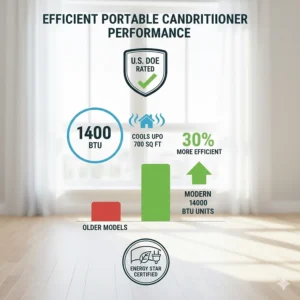
| AirOrig 14000 BTU | 14,000 BTU (DOE Certified) | Up to 700 sq ft | 30% More Efficient, Inverter Tech | Below 45 dB | $500-$600 |
| EUHOMY 14000 BTU | 14,000 BTU (ASHRAE) | Up to 700 sq ft | Turbo Mode, 4 Wind Speeds | 46 dB | $360-$460 |
| Humhold 14000 BTU | 14,000 BTU / 10,000 BTU (SACC) | 550-700 sq ft | 3-in-1, Auto Swing, Sleep Mode | Standard | $370-$470 |
| GarveeTech 14000 BTU | 14,000 BTU (ASHRAE) | 550-750 sq ft | 90 pt/day Dehumidifier, 24H Timer | 50-52 dB | $400-$500 |
💬 Just one click – help others make better buying decisions too!😊
Top 7 Portable Air Conditioner 14000 BTU: Expert Analysis
1. Tanoxo 14000 BTU Portable Air Conditioner – Best Overall Value
The Tanoxo 14000 BTU represents exceptional engineering at a competitive price point. This large room portable AC delivers 14,000 BTU (ASHRAE) with a realistic 10,000 BTU (SACC) rating, efficiently cooling spaces up to 700 square feet.
Key Specifications:
- Advanced high-capacity compressor with 450 m³/hr airflow
- Temperature range: 61°F-88°F (adjustable in 1°F increments)
- Dehumidification: 96.2 pints per day
- Dimensions: 14.06″ x 16.5″ x 27.09″
What sets this unit apart is the automatic evaporation system – say goodbye to constant drainage under 85% humidity conditions. The smart mode intelligently switches between cooling and fan modes based on internal temperature sensors, while sleep mode operates whisper-quiet at below 48 dB.
Pros:
✅ Exceptional cooling efficiency for the price
✅ Auto-swing function for even temperature distribution
✅ Child lock feature for family safety
Cons:
❌ Manual drainage required in extreme humidity (>85%)
❌ Remote range limited to 23 feet
Customer Feedback: Users consistently praise the rapid cooling and quiet operation, noting it effectively maintains comfortable temperatures in rooms up to 700 sq ft.
Price Range: $350-$450

2. BLACK+DECKER Smart Portable Air Conditioner BPACT14HWT – Best Smart Features
The BLACK+DECKER BPACT14HWT brings intelligent climate control to your fingertips. This 4-in-1 powerhouse combines 14,000 BTU cooling (10,200 BTU SACC) with 12,000 BTU heating capacity, making it a true year-round solution.
Key Specifications:
- WiFi-enabled with iOS/Android app control
- Compatible with Amazon Alexa and Google Assistant
- Follow Me remote with thermostat function
- Dimensions: 16.5″ x 14.06″ x 27.09″
The commercial grade technology shines through voice control integration – adjust settings without leaving your couch. The Follow Me feature uses the remote as a mobile thermostat, ensuring your exact location stays perfectly comfortable rather than relying on the unit’s built-in sensor.
Pros:
✅ Smart home integration (Alexa, Google Assistant)
✅ Dual heating and cooling functions
✅ Follow Me precision temperature control
Cons:
❌ Higher initial cost
❌ Slightly heavier at 63.6 lbs
Customer Feedback: Tech-savvy users love the app control and voice commands, reporting seamless integration with existing smart home ecosystems.
Price Range: $450-$550
3. DOMANKI 14000 BTU Portable Air Conditioner with Heater – Best All-Season Unit
The DOMANKI 14000 BTU excels as a versatile climate control solution. With 14,000 BTU cooling and 12,500 BTU heating capacity, this high capacity compressor system tackles temperature extremes year-round.
Key Specifications:
- ETL certified energy-efficient compressor
- Operating range: 61°F-88°F
- 4-in-1 functionality: Cooling, Heating, Fan, Dehumidifier
- Built-in automatic evaporation system
The unit’s 48-decibel sleep mode creates a peaceful environment while maintaining optimal temperatures. The 360-degree casters and built-in handles make repositioning effortless, perfect for homes needing flexible cooling solutions.
Pros:
✅ Year-round heating and cooling
✅ Auto-adjustment in sleep mode
✅ Removable, washable double filter
Cons:
❌ Heating coverage limited to 550 sq ft
❌ Window kit fits standard sliding windows only
Customer Feedback: Reviewers appreciate the dual-season functionality, especially those in moderate climates who need occasional heating.
Price Range: $380-$480
4. AirOrig 14000 BTU Portable Air Conditioner – Most Energy Efficient
The AirOrig 14000 BTU stands out with cutting-edge inverter technology that delivers 30% greater efficiency compared to conventional units. DOE/CEC/CSA certified, this powerful portable air conditioner saves approximately $1,000 annually in energy costs according to manufacturer testing.
Key Specifications:
- Ultra-quiet inverter compressor (<45 dB)
- Advanced cooling technology with 360° airflow
- 36°F rapid temperature drop capability
- Whisper-quiet brushless fan system
The energy efficiency doesn’t compromise performance – this unit rapidly cools spaces up to 700 sq ft while effectively reducing humidity. The sub-45 dB operation makes it library-quiet, ideal for bedrooms or home offices.
Pros:
✅ Industry-leading energy efficiency
✅ Quietest operation in class (<45 dB)
✅ Rapid cooling performance
Cons:
❌ Premium price point
❌ Limited color options
Customer Feedback: Energy-conscious buyers report noticeably lower electricity bills and appreciate the near-silent operation during nighttime use.
Price Range: $500-$600
5. EUHOMY 14000 BTU Portable Air Conditioner – Best Cooling Speed
The EUHOMY 14000 BTU features an upgraded compressor designed for rapid temperature reduction. With turbo mode and four wind speeds, this unit excels at quick-cooling applications.
Key Specifications:
- Temperature range: 61°F-90°F
- 4-in-1 modes: Cool, Dry, Fan, Sleep
- Turbo function for maximum airflow
- Light-off function for undisturbed sleep
The turbo mode pushes maximum airflow through the system, cooling rooms faster than standard operation. At just 46 dB in sleep mode, it balances power with quiet operation. The 24-hour timer offers automated shutdown for energy savings.
Pros:
✅ Fastest cooling in its class
✅ Four adjustable wind speeds
✅ Light-off function for total darkness
Cons:
❌ Higher noise in turbo mode
❌ Standard remote range
Customer Feedback: Users in hot climates praise the turbo mode’s ability to rapidly cool sun-baked rooms, noting significant temperature drops within 10-15 minutes.
Price Range: $360-$460
6. Humhold 14000 BTU Portable Air Conditioner – Best Design
The Humhold 14000 BTU combines functionality with sleek aesthetics. This 3-in-1 system delivers reliable cooling for 550-700 sq ft spaces with intuitive controls and modern styling.
Key Specifications:
- 14,000 BTU (ASHRAE) / 10,000 BTU (SACC)
- 3-speed fan operation
- Auto-swing louvers for even distribution
- 24-hour programmable timer
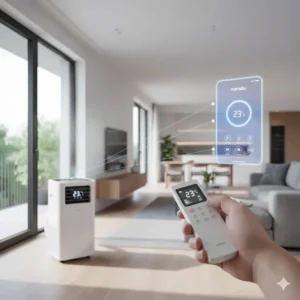
The streamlined design fits seamlessly into contemporary interiors while delivering serious cooling power. The LED-backlit remote (23ft range) offers convenient control from across the room, and the touch-sensitive display provides at-a-glance status updates.
Pros:
✅ Modern, attractive design
✅ Intuitive control interface
✅ Reliable performance
Cons:
❌ Fewer advanced features than competitors
❌ Standard efficiency ratings
Customer Feedback: Design-conscious buyers appreciate how the unit blends with their décor while delivering consistent cooling performance.
Price Range: $370-$470
7. GarveeTech 14000 BTU Portable Air Conditioner – Best Dehumidification
The GarveeTech 14000 BTU excels at moisture removal with an impressive 90 pints per day dehumidification capacity. This makes it ideal for humid climates or basement applications.
Key Specifications:
- Cooling coverage: 550-750 sq ft
- Exceptional 90 pt/day dehumidification
- 4-in-1 functionality with sleep mode
- Quiet operation: 50 dB (low) / 52 dB (high)
The robust dehumidification system tackles humidity while cooling, creating a more comfortable environment in sticky conditions. The comprehensive window kit ensures easy installation, and 360° swivel wheels provide effortless mobility.
Pros:
✅ Superior dehumidification capacity
✅ Effective in high-humidity environments
✅ Complete installation kit included
Cons:
❌ Slightly higher noise levels
❌ Heavier unit due to enhanced components
Customer Feedback: Users in coastal or humid regions report dramatic improvements in comfort, noting the unit handles both temperature and humidity exceptionally well.
Price Range: $400-$500
What Is Portable Air Conditioner 14000 BTU? Understanding Cooling Power
A portable air conditioner 14000 BTU is a self-contained cooling unit capable of removing 14,000 British Thermal Units of heat per hour from indoor air. These powerful systems effectively cool spaces ranging from 550 to 700 square feet without requiring permanent installation or ductwork modifications.
The magic lies in the refrigeration cycle: warm air gets pulled into the unit, passes over cold evaporator coils filled with refrigerant, and cooled air circulates back into your room while hot air vents outside through an exhaust hose. It’s essentially a window AC unit reimagined with portability and flexibility.
What differentiates 14000 BTU models from smaller units? Pure cooling muscle. According to Trane’s HVAC guidelines, properly sized units deliver approximately 20 BTU per square foot. A 14000 BTU system can handle 700 sq ft of space – that’s a large master bedroom or spacious home office.
The ASHRAE (American Society of Heating, Refrigerating and Air-Conditioning Engineers) rating indicates theoretical maximum capacity under ideal conditions, while the SACC (Seasonally Adjusted Cooling Capacity) reflects real-world performance accounting for factors like humidity, ambient temperature, and airflow restrictions. Most 14000 BTU (ASHRAE) units deliver around 9,000-10,000 BTU (SACC) in practice.
Benefits of High BTU Portable AC Units Over Traditional Systems
Maximum Cooling Area Coverage
High BTU portable AC units dominate when square footage demands serious power. While 8000-10000 BTU models struggle beyond 400 sq ft, 14000 BTU systems confidently tackle 550-700 sq ft spaces. This makes them perfect for:
- Master bedrooms with high ceilings
- Open-concept living areas
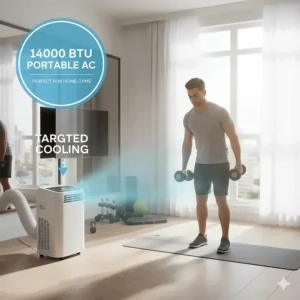
- Home gyms with heat-generating equipment
- Garage workshops
- Converted basement spaces
The difference becomes palpable during heat waves – smaller units run constantly trying to maintain comfortable temperatures, while a properly sized powerful portable air conditioner cycles efficiently.
Installation Freedom & Flexibility
Traditional central air requires thousands in installation costs, extensive ductwork, and professional contractors. Portable air conditioner 14000 BTU units? Ten minutes, a window, and you’re cooling. This flexibility proves invaluable for:
Renters: No landlord permission required, take it when you move
Homeowners: Supplement central air in problem areas
Temporary spaces: Cool finished basements, converted garages, or seasonal rooms
Budget-conscious buyers: Avoid $5,000-$15,000 central AC installation costs
The exhaust hose vents through standard sliding windows, double-hung windows, or even drop ceiling tiles in commercial settings. Most units include comprehensive window kits compatible with openings from 20″ to 49″ wide.
Energy Efficiency & Cost Savings
Modern portable air conditioner 14000 BTU units incorporate energy-saving technologies that dramatically reduce operating costs compared to central systems cooling entire homes. Consider:
Zone cooling: Only cool occupied rooms rather than the entire house
Smart features: Programmable timers, sleep modes, and auto-shutoff prevent wasted energy
Inverter technology: Advanced models like the AirOrig adjust compressor speed dynamically, reducing energy consumption by 30%
According to the Department of Energy, properly sized room air conditioners operate more efficiently than oversized units because they run longer cycles that better control humidity and temperature.
Key Features to Consider in Powerful Portable Air Conditioners
Cooling Capacity: BTU Ratings Decoded
Understanding BTU ratings prevents the two most common mistakes: buying too small (constant running, inadequate cooling) or too large (short cycling, poor humidity control, higher costs).
Calculate your needs:
- Measure room dimensions (length × width × height)
- Use 20 BTU per square foot as baseline (Carrier’s HVAC guidelines)
- Adjust for variables:
- Sun-facing rooms: Add 10% BTU
- Kitchens: Add 4,000 BTU
- Rooms with 4+ people: Add 600 BTU per additional person
- Poor insulation: Add 15-20% BTU
Example: A 600 sq ft living room with west-facing windows needs approximately 13,200 BTU (600 × 20 × 1.10), making a 14000 BTU unit ideal.
Noise Levels: The Decibel Factor
Sleep quality and work focus depend on quiet operation. Noise levels in portable air conditioner 14000 BTU units range from 45-55 dB:
- 45-48 dB: Library-quiet, suitable for bedrooms
- 48-52 dB: Quiet conversation level, acceptable for living areas
- 52-55 dB: Noticeable but manageable, fine for workshops
Look for units with dedicated sleep modes that prioritize quiet operation by reducing fan speeds and compressor cycling. The AirOrig’s <45 dB operation sets the gold standard, while budget models may reach 55+ dB at maximum power.
Smart Features & Controls
Modern portable air conditioner 14000 BTU units offer impressive connectivity:
WiFi Integration: Control temperature from anywhere via smartphone apps
Voice Control: Amazon Alexa and Google Assistant compatibility
Programmable Timers: 24-hour scheduling prevents wasted energy
Auto Mode: Sensors detect room conditions and adjust cooling automatically
Follow Me Function: Remote acts as mobile thermostat for precise local control
Smart features add $50-$150 to unit costs but deliver convenience and energy savings that justify the investment.
Dehumidification Capacity
High BTU portable AC units double as powerful dehumidifiers, removing 80-100 pints of moisture daily. This proves crucial in humid climates where excess moisture makes air feel warmer than actual temperature.
Look for units with auto-evaporation systems that recycle condensation internally, eliminating manual drainage in normal conditions (≤85% humidity). Only extreme humidity or dedicated dehumidifier mode requires manual drainage.
Portable Air Conditioner 12000 BTU vs 14000 BTU: Which Size Is Right?
Choosing between portable air conditioner 12000 BTU and 14000 BTU models hinges on precise room sizing and cooling demands.
Coverage Comparison
| Specification | 12000 BTU | 14000 BTU |
|---|---|---|
| Maximum Area | 400-550 sq ft | 550-700 sq ft |
| Ideal Room Size | Bedrooms, small offices | Master bedrooms, large living rooms |
| Dehumidification | 70-80 pints/day | 85-100 pints/day |
| Power Consumption | ~1,100W | ~1,300W |
| Average Weight | 55-65 lbs | 60-70 lbs |
When 12000 BTU Suffices
Choose a portable air conditioner 12000 BTU for:
- Rooms 350-500 sq ft with standard 8-9 foot ceilings
- Well-insulated spaces with minimal sun exposure
- Areas without heat-generating equipment
- Moderate climates (summer highs below 95°F)
- Single occupancy bedrooms
When 14000 BTU Becomes Essential
Upgrade to 14000 BTU units for:
- Spaces 500-700 sq ft requiring powerful cooling
- Rooms with cathedral ceilings (10+ feet)
- Sun-facing rooms with large windows
- Home gyms, kitchens, or electronics-filled spaces
- Hot climates (summer highs exceeding 100°F)
- Poorly insulated older homes
Real-world example: A 500 sq ft bedroom with standard insulation works fine with 12000 BTU. That same 500 sq ft converted into a home gym with treadmill and weights? The heat generated by exercise equipment and occupants demands 14000 BTU capacity.
Installation & Setup: Getting Your Large Room Portable AC Running
Step-by-Step Installation Guide
Tools Needed:
- Measuring tape
- Screwdriver (usually Phillips)
- Level (optional but recommended)
Installation Process:
Step 1: Position Selection (5 minutes) Place unit within 4-6 feet of a suitable window. Ensure adequate clearance: 12″ from walls, 24″ in front for airflow. Choose locations away from direct sunlight and heat sources.
Step 2: Window Kit Assembly (10 minutes) Most units include adjustable window kits fitting openings from 20″-49″ wide:
- Extend sliding panel to match window width
- Secure with provided locks or screws
- Seal gaps with foam weather stripping
- Ensure tight fit to prevent air leakage
Step 3: Exhaust Hose Connection (5 minutes)
- Attach adapter to window kit opening
- Connect exhaust hose(s) to unit and window adapter
- Minimize hose length and bends for optimal efficiency
- Secure connections with clamps or twist locks
Step 4: Power Up (2 minutes) Plug into dedicated 15-20 amp circuit. Avoid extension cords or power strips – portable air conditioner 14000 BTU units draw 10-14 amps requiring direct outlet connection.
Optimizing Performance
Window Installation Tips:
✅ Keep exhaust hose as short and straight as possible
✅ Insulate hose with foam sleeve in extreme climates
✅ Ensure window seals completely around panel
✅ Tilt unit slightly backward (if design permits) for drainage
Placement Strategies:
- Corner installations benefit from bi-directional airflow units
- Central locations distribute air more evenly
- Avoid placement behind furniture blocking airflow
- Elevate slightly on stable platform if floors flood during storms
Maintenance Tips for Long-Lasting Performance
Regular maintenance extends lifespan and maintains efficiency of your powerful portable air conditioner.
Weekly Maintenance (5 minutes)
Filter Cleaning: Most units feature removable, washable filters requiring weekly attention during heavy use:
- Power off and unplug unit
- Remove filter access panel (usually rear or side)
- Vacuum loose dust and debris
- Wash with mild soap and warm water
- Air dry completely before reinstalling (never use damp filters)
Clean filters improve airflow by 15-25%, reducing energy consumption and extending compressor life.
Monthly Maintenance (15 minutes)
Drainage Check: Even units with auto-evaporation systems benefit from monthly drainage:
- Check internal water level indicator
- If equipped with drain plug, drain condensate tank
- Inspect drain hose for clogs or kinks
- Clean condensate pan with mild bleach solution (1:10 ratio) to prevent mold
Exterior Cleaning:
- Wipe housing with damp cloth
- Clean air intake grilles
- Remove dust from exhaust hose
- Inspect window seal for gaps
Seasonal Maintenance (30 minutes)
Pre-Season Preparation (Spring):
- Deep clean or replace filters
- Inspect exhaust hose for cracks or tears
- Test all functions (cooling, fan speeds, modes)
- Clean evaporator and condenser coils (if accessible)
- Verify window kit hardware condition
End-of-Season Storage (Fall):
- Run fan-only mode for 24 hours to dry internal components
- Drain all condensate completely
- Clean and dry filters thoroughly
- Disconnect and store exhaust hose
- Cover unit with breathable cloth (prevents dust while allowing air circulation)
- Store in climate-controlled space if possible
Professional Maintenance
Consider annual professional servicing ($75-$150) for:
- Refrigerant level checks
- Compressor efficiency testing
- Deep coil cleaning
- Electrical connection inspection
- Thermostat calibration
Commercial Grade Options for Business Use
While residential portable air conditioner 14000 BTU units suit most applications, commercial settings demand enhanced durability and performance.
Commercial vs Residential Units
Key Differences:
Construction Quality:
- Commercial units feature reinforced housing and commercial-grade components
- Higher duty-cycle ratings (operate continuously without rest periods)
- Corrosion-resistant materials for harsh environments
- Industrial-grade casters rated for frequent movement
Performance Specifications:
- Tighter temperature control (±1°F vs ±3°F)
- Faster cooling recovery after door openings
- Enhanced air filtration (MERV 11+ vs MERV 8)
- Louder operation acceptable in non-office settings
Warranty Coverage:
- Commercial warranties: 3-5 years parts, 5-10 years compressor
- Residential warranties: 1-2 years parts, 5 years compressor
- Commercial support includes priority service
Ideal Commercial Applications
Retail Environments:
- Supplement AC in high-traffic areas
- Cool stockrooms and back offices
- Provide backup during AC failures
- Handle heat from display lighting
Industrial Settings:
- Cool control rooms and workstations
- Manage heat from machinery
- Provide spot cooling in warehouses
- Support temperature-sensitive operations
Events & Hospitality:
- Emergency cooling during AC outages
- Temporary installations for events
- Seasonal operation in fairground buildings
- Food service prep areas
Professional Services:
- Server rooms (14000 BTU portable AC works as backup)
- Medical offices and clinics
- Photography studios
- Salons and spas
Energy Efficiency & Operating Costs
Understanding the true cost of operating a portable air conditioner 14000 BTU helps make informed purchasing decisions.
Calculating Energy Consumption
Basic Formula:
- Wattage ÷ 1,000 × Hours Used × Electricity Rate = Daily Cost
Example Calculation: A 14000 BTU unit drawing 1,300 watts, running 8 hours daily at $0.14/kWh:
- 1.3 kW × 8 hours = 10.4 kWh per day
- 10.4 kWh × $0.14 = $1.46 per day
- Monthly cost: $1.46 × 30 = $43.80
Energy-Saving Strategies
Thermostat Management:
- Raise temperature 2-3°F during peak hours (saves 10-15%)
- Use sleep mode at night (reduces consumption 20-30%)
- Program timers to pre-cool before occupancy
Physical Optimization:
- Close blinds during peak sun hours
- Seal air leaks around windows and doors
- Use ceiling fans to distribute cool air
- Close doors to unused rooms
Smart Usage Patterns:
- Run during off-peak electricity hours when rates lower
- Utilize economy or eco modes
- Clean filters regularly (15-25% efficiency improvement)
- Maintain proper clearances for airflow
EER and CEER Ratings
Energy Efficiency Ratio (EER): BTU output ÷ Watts consumed
- Good: 8.0-9.5 EER
- Better: 9.5-11.0 EER
- Best: 11.0+ EER
Higher EER means more cooling per dollar spent. A unit with 10.0 EER costs approximately 15% less to operate than one with 8.5 EER.
Combined Energy Efficiency Ratio (CEER): Accounts for standby power consumption and additional factors for more realistic efficiency measurement.
Troubleshooting Common Issues
Even high-quality portable air conditioner 14000 BTU units occasionally need troubleshooting.
Unit Won’t Cool Effectively
Possible Causes:
Undersized for Space: Verify room dimensions match BTU capacity. Factors like high ceilings, poor insulation, or excessive sun exposure may require higher capacity.
Exhaust Issues:
- Ensure hose isn’t kinked or crushed
- Check for air leaks around window kit
- Verify hose extends fully outside
- Confirm hot air exhausts freely
Filter Blockage: Clogged filters reduce airflow by 50%+ causing inadequate cooling despite compressor running.
Low Refrigerant: If unit runs but produces minimal cooling, refrigerant may have leaked. Requires professional service.
Excessive Noise
Normal Operating Sounds:
- Compressor hum (40-55 dB depending on model)
- Fan whoosh (increases with higher speeds)
- Occasional clicking (thermostat cycling)
Abnormal Noises:
Rattling: Loose panels or internal components
- Solution: Tighten external screws, contact service if internal
Grinding: Bearing wear or debris in fan
- Solution: Professional inspection required
Bubbling: Normal refrigerant flow sounds
- Not a problem unless excessive
Buzzing: Electrical issue or loose wiring
- Solution: Unplug immediately, professional service needed
Water Leakage
Internal Condensate Overflow:
- Empty drain tank if equipped
- Check automatic evaporation function operates correctly
- Ensure unit sits level (tilted units drain improperly)
External Condensation:
- Normal in high humidity – wipe condensation from exterior
- Add foam insulation to exhaust hose if sweating excessively
Drain Hose Issues:
- Verify drain isn’t clogged
- Ensure proper slope for gravity drainage
- Check drain connection seals tightly
Portable Air Conditioner 14000 BTU for Specific Room Types
Master Bedrooms
Large bedrooms (300-500 sq ft) with standard ceilings work perfectly with portable air conditioner 14000 BTU units. Prioritize quiet operation (≤48 dB) and sleep modes that dim displays.
Optimization Tips:
- Position opposite bed to avoid direct airflow
- Use timer to pre-cool 30 minutes before bedtime
- Set 2-3°F warmer than daytime for comfortable sleep
- Enable auto-swing for even temperature distribution
Recommended Models:
- AirOrig 14000 BTU (<45 dB library-quiet)
- EUHOMY with light-off function
- Tanoxo with below-48 dB sleep mode
Home Offices
Climate-controlled workspaces boost productivity significantly. A 14000 BTU unit handles 400-700 sq ft offices while accommodating heat from computers, monitors, and printers.
Productivity Enhancement:
- Maintain 68-72°F for optimal cognitive function
- Use auto mode to prevent temperature fluctuations
- Position to avoid papers blowing around
- Select quieter models for Zoom calls
Ideal Features:
- Smart controls for remote adjustment
- Precise temperature settings (1°F increments)
- Moderate noise levels (48-52 dB acceptable)
Living Rooms & Open Concepts
Open-concept spaces often exceed single portable unit capacity. For areas 500-700 sq ft, a powerful portable air conditioner 14000 BTU provides adequate cooling, particularly when supplementing central air.
Strategic Placement:
- Corner positioning with bi-directional airflow
- Central location for maximum distribution
- Near return air grilles if supplementing central AC
Feature Priorities:
- Auto-swing louvers essential
- Multiple fan speeds for air circulation
- Dehumidification capacity 85+ pints/day
Garage Workshops
Uninsulated garages present cooling challenges due to poor insulation and heat-generating equipment. A 14000 BTU unit manages 400-500 sq ft garage spaces with realistic expectations.
Workshop Considerations:
- Calculate BTU needs assuming poor insulation (add 20%)
- Position away from dust-generating work areas
- Use frequent filter cleaning
- Consider supplementing with exhaust fans
Basement Spaces
Finished basements benefit from portable cooling, especially in homes without ductwork extensions. High humidity in basements makes dehumidification capacity crucial.
Basement-Specific Tips:
- Select units with 90+ pint/day dehumidification
- Ensure adequate condensate drainage
- Position away from moisture sources
- Monitor for mold prevention (keep humidity <60%)
Environmental Impact & Eco-Friendly Operation
Modern portable air conditioner 14000 BTU units incorporate environmentally conscious technologies reducing climate impact.
Refrigerant Types
R-32 Refrigerant:
- Global Warming Potential (GWP): 675
- 68% lower than traditional R-410A (GWP: 2,088)
- Better energy efficiency
- Easier recovery and recycling
R-410A Refrigerant:
- Still widely used but being phased out
- Higher environmental impact
- Proven reliability and performance
When possible, choose R-32 units for reduced environmental footprint.
Energy Star Certification
While portable air conditioners aren’t currently eligible for Energy Star certification, look for units meeting or exceeding CEER thresholds:
- Standard efficiency: 8.5-9.5 CEER
- High efficiency: 10.0-11.0 CEER
- Premium efficiency: 11.0+ CEER
Higher efficiency units cost $50-$100 more initially but save $100-$200 annually in electricity costs.
Sustainable Usage Practices
Reduce Overall Consumption:
- Supplement rather than replace efficient central AC
- Use during peak heat hours only
- Combine with passive cooling (fans, shades)
- Maintain proper insulation
End-of-Life Disposal: Never discard portable AC units in regular trash. Refrigerants require professional recovery:
- Contact local hazardous waste facilities
- Many retailers offer recycling programs
- Manufacturers may accept old units for recycling
- Scrap metal dealers accept properly recovered units
Price Range & Value Analysis
Portable air conditioner 14000 BTU units range from $300 to $650+ depending on features and build quality.
Budget Tier ($300-$400)
What You Get:
- Basic cooling functionality
- Standard remote control
- Manual or basic timers
- 1-year warranties
- 50-55 dB noise levels
Who Benefits:
- Renters needing temporary solutions
- Seasonal use (3-4 months annually)
- Single-room applications
- Budget-conscious buyers
Examples:
- Tanoxo 14000 BTU ($350-$450)
- EUHOMY 14000 BTU ($360-$460)
Mid-Range Tier ($400-$500)
What You Get:
- Enhanced build quality
- Smart features (WiFi, app control)
- Better noise reduction (48-52 dB)
- Improved energy efficiency
- 2-year warranties
Who Benefits:
- Homeowners seeking quality
- Year-round use potential
- Smart home enthusiasts
- Multiple-room flexibility
Examples:
- DOMANKI with heater ($380-$480)
- GarveeTech ($400-$500)
- Humhold ($370-$470)
Premium Tier ($500-$650+)
What You Get:
- Inverter technology
- Ultra-quiet operation (<48 dB)
- Voice control integration
- Commercial-grade components
- 3-5 year warranties
- Advanced air filtration
Who Benefits:
- Energy-conscious buyers (ROI through savings)
- Noise-sensitive environments
- Long-term investment seekers
- Tech enthusiasts
Examples:
- AirOrig with inverter tech ($500-$600)
- BLACK+DECKER smart models ($450-$550)
Total Cost of Ownership
5-Year Cost Comparison:
Budget Unit ($350):
- Purchase: $350
- Energy (avg): $500/year × 5 = $2,500
- Maintenance: $100
- Total: $2,950
Premium Efficient Unit ($550):
- Purchase: $550
- Energy (30% savings): $350/year × 5 = $1,750
- Maintenance: $100
- Total: $2,400
The premium unit saves $550 over five years despite higher upfront cost, plus offers better comfort, quieter operation, and longer lifespan.
Safety Considerations & Best Practices
Operating portable air conditioner 14000 BTU units safely protects family and property.
Electrical Safety
Circuit Requirements:
- Dedicated 15-20 amp circuit
- Grounded three-prong outlet
- No daisy-chained extension cords
- GFCI protection recommended near water sources
Warning Signs:
- Outlet feels warm during operation
- Circuit breaker trips repeatedly
- Burning smell from plug or outlet
- Flickering lights when unit starts
Never:
- Use with extension cords
- Plug into power strips
- Share circuit with major appliances
- Operate with damaged power cord
Ventilation Safety
Proper Exhaust: Inadequate exhaust venting creates carbon monoxide risks and reduces efficiency:
- Ensure hose extends completely outside
- Seal all gaps around window kit
- Never block or restrict exhaust opening
- Inspect regularly for disconnections
Room Ventilation: While cooling, portable units consume slight amounts of room air. In extremely tight spaces (under 200 sq ft), crack window slightly for fresh air circulation.
Fire Prevention
Clearance Requirements:
- 12″ from walls and furniture
- 24″ in front for airflow
- Keep clear of curtains, bedding
- Don’t cover unit during operation
Flammable Materials:
- Never store gasoline, paint, or solvents near unit
- Keep away from aerosol cans
- Maintain clear path for air intake/exhaust
Child & Pet Safety
Physical Hazards:
- Hot exhaust hose can burn skin
- Heavy units (60-70 lbs) tip easily
- Moving parts pose pinch hazards
- Electrical cord creates trip hazard
Safety Features:
- Choose units with child lock functions
- Use cord management systems
- Position where pets can’t access
- Teach children units aren’t toys
Comparison: Large Room Portable AC vs Other Cooling Options
vs Window Air Conditioners
Portable Advantages:
✅ No permanent installation
✅ Move between rooms
✅ Renter-friendly
✅ No exterior mounting required
Window Unit Advantages:
✅ 15-20% more efficient (dual-hose portables comparable)
✅ Slightly quieter
✅ Don’t consume floor space
✅ Better suited for 24/7 operation
Best For:
- Portable: Renters, temporary spaces, homes without suitable windows
- Window: Permanent installations, continuous operation, maximum efficiency
vs Split System Mini-Splits
Portable Advantages:
✅ No installation costs ($0 vs $2,000-$4,000)
✅ DIY setup
✅ Take with you when moving
✅ No special electrical requirements
Mini-Split Advantages:
✅ Superior efficiency (SEER 18-30 vs 8-12)
✅ Whisper-quiet operation
✅ Heating and cooling
✅ Multiple indoor units possible
✅ Permanent solution
Best For:
- Portable: Short-term needs, rentals, budget constraints
- Mini-Split: Long-term investment, whole-home solutions, maximum efficiency
vs Central Air Conditioning
Portable Advantages:
✅ Fraction of installation cost ($400 vs $5,000-$15,000)
✅ Zone cooling saves energy
✅ Backup during AC failures
✅ Supplement insufficient central AC
Central AC Advantages:
✅ Whole-home cooling
✅ Invisible operation
✅ Higher resale value
✅ Integrated with HVAC system
Best For:
- Portable: Supplemental cooling, specific rooms, rental properties
- Central AC: Permanent homes, whole-house needs, long-term value
vs Evaporative Coolers
Portable Advantages:
✅ Works in humid climates (evaporative fails)
✅ Precise temperature control
✅ Doesn’t add moisture
✅ Effective in any weather
Evaporative Advantages:
✅ 75% lower operating costs
✅ No exhaust hose needed
✅ Adds beneficial humidity in dry climates
✅ Simple maintenance
Best For:
- Portable: Humid climates, precise cooling, all weather conditions
- Evaporative: Arid climates (Southwest US), extreme budget constraints
FAQ: Your Portable Air Conditioner 14000 BTU Questions Answered
❓ How many square feet does a portable air conditioner 14000 BTU cool effectively?
❓ Do portable air conditioner 14000 BTU units need drainage?
❓ Can I use a portable air conditioner 14000 BTU in a room without windows?
❓ How much electricity does a high BTU portable AC use per hour?
❓ What's the difference between ASHRAE and SACC BTU ratings?
Conclusion: Finding Your Perfect Powerful Portable Air Conditioner
After diving deep into the world of portable air conditioner 14000 BTU units, one truth emerges: there’s no universal “best” choice – only the best choice for your specific needs.
If energy efficiency tops your priorities, the AirOrig 14000 BTU with inverter technology delivers unmatched performance and whisper-quiet operation that justifies its premium price through long-term savings. Tech enthusiasts will appreciate the BLACK+DECKER BPACT14HWT with its smart home integration and voice control capabilities.
Budget-conscious buyers won’t go wrong with the Tanoxo 14000 BTU, offering exceptional value with solid performance and quiet operation. For year-round climate control, the DOMANKI combines powerful cooling with 12,500 BTU heating capacity, while the GarveeTech excels in humid environments with its impressive 90 pints/day dehumidification.
The bottom line? A properly sized portable air conditioner 14000 BTU transforms uncomfortable spaces into comfortable sanctuaries without the hassle and expense of permanent installation. Calculate your square footage, consider your specific needs (quiet operation, smart features, heating capability), set your budget, and choose accordingly.
Remember that these high BTU portable AC units represent significant investments in comfort. Don’t sacrifice quality for minor savings – the difference between a $350 budget model and a $500 premium unit amounts to $30 over five years when factoring energy costs. Choose the best powerful portable air conditioner your budget allows, maintain it properly, and enjoy years of reliable cooling.
Recommended for You
- 7 Best Small Portable Air Conditioners 2026 – BTU Buyer’s Guide
- 7 Best Dual Hose Portable Air Conditioner Units 2026
- 7 Best Portable Air Conditioner Without Hose 2026
Disclaimer: This article contains affiliate links. If you purchase products through these links, we may earn a small commission at no additional cost to you.
✨ Found this helpful? Share it with your friends! 💬🤗
