
In This Article
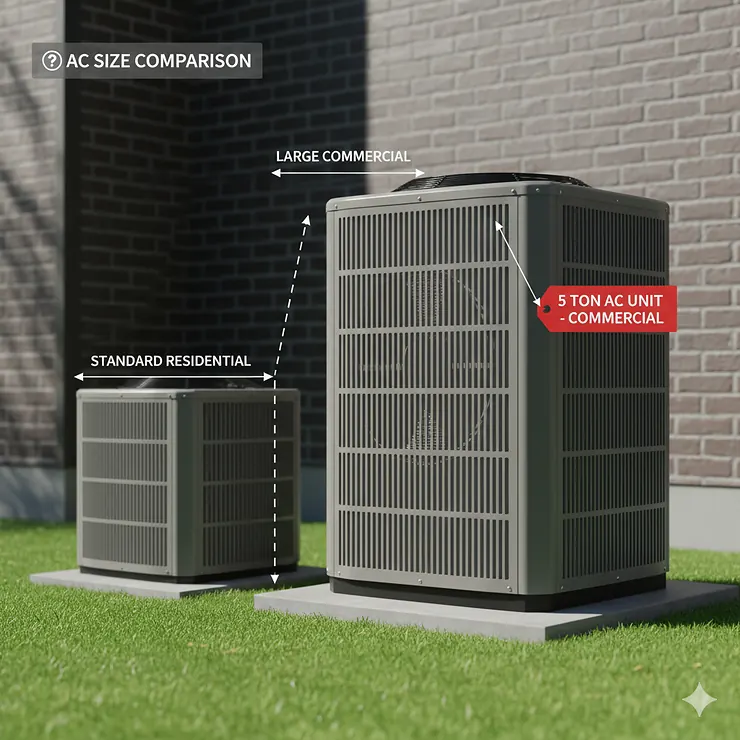
When you’re dealing with large commercial spaces or expansive residential areas, finding the right cooling solution becomes absolutely critical. A 5 ton air conditioner represents the sweet spot between residential and full commercial systems, delivering an impressive 60,000 BTU of cooling power that can handle spaces up to 3,000 square feet with ease. Whether you’re managing an office building, retail space, or a sprawling home, understanding the intricacies of these powerful cooling systems will help you make an informed decision that saves money and delivers reliable comfort for years to come.
✨Was this helpful? Spread the word! 🚀
The landscape of 5 ton air conditioner technology has evolved dramatically in recent years, with manufacturers pushing the boundaries of energy efficiency while maintaining robust cooling performance. Today’s units feature advanced inverter technology, smart controls, and eco-friendly refrigerants that not only reduce environmental impact but also significantly lower operating costs. From budget-friendly options to premium systems with cutting-edge features, there’s never been a better time to invest in a high-capacity cooling solution.
Understanding 5 Ton Air Conditioner Fundamentals 🏗️
What Makes a 5 Ton Air Conditioner Special
The term “ton” in air conditioning doesn’t refer to weight but rather to cooling capacity. One ton equals the ability to remove 12,000 British Thermal Units (BTUs) of heat per hour, making a 5 ton air conditioner capable of removing 60,000 BTUs hourly. This massive cooling power positions these units perfectly for applications that require serious climate control without stepping into full industrial territory.
Modern 5 ton air conditioner systems incorporate sophisticated technology that goes far beyond simple cooling. Variable-speed compressors adjust output based on real-time demand, while advanced refrigerant systems like R-32 and R-454B provide better efficiency and environmental benefits compared to older R-410A systems. The integration of smart controls allows for precise temperature management and energy optimization that can reduce operating costs by up to 30% compared to older single-stage systems.
Commercial vs Residential Applications
When considering a 5.0 ton air conditioner, understanding the application differences becomes crucial. Commercial installations typically involve more complex ductwork, higher electrical requirements, and specialized controls that accommodate varying occupancy levels throughout the day. Residential applications, while simpler in design, require careful consideration of home layout, insulation quality, and zoning requirements to ensure optimal performance.
The distinction becomes particularly important when evaluating warranty coverage and service requirements. Commercial-grade 5 ton AC unit for commercial applications often come with extended warranties but may require professional maintenance contracts, while residential units typically offer homeowner-friendly service options and more straightforward installation procedures.
Top 7 Real 5 Ton Air Conditioner Models Available Now 💪
Premium Performance Category
1. Trane 5 Ton XV20i Series Variable Speed Air Conditioner
The Trane 5 Ton XV20i Series 60000 BTU 4TTV0060A1000C unit is a 20 SEER outdoor Variable Speed Air Conditioner Condenser and offers the most cost efficiency from Trane’s line of air conditioners. This premium unit represents the pinnacle of residential cooling technology, featuring TruComfort™ variable speed technology that provides precise temperature control within 0.5°F of your desired setting.
Key Specifications:
- ⚡ 20 SEER2 efficiency rating
- 🔧 Variable speed compressor technology
- 🛡️ WeatherGuard™ fasteners for corrosion resistance
- 📱 Compatible with advanced smart thermostats
- 💨 Quiet operation at 69 dB
Price Range: $8,500 – $12,000 (unit only)
Customer reviews consistently praise this unit’s whisper-quiet operation and exceptional efficiency. One verified buyer noted that their monthly cooling costs dropped by 40% after upgrading from a 13 SEER unit, making the higher initial investment worthwhile within three cooling seasons.
2. YMGI 60000 BTU 5 Ton Multi-Zone Ductless Mini Split System
The YMGI 60000 BTU 5 Ton 5 Zone Ductless Mini Split System features advance heat pump technology that enables cooling, heating and dehumidification with greatest efficiency, powered by a world class DC inverter compressor rated at 21 SEER efficiency. This system excels in applications where traditional ductwork isn’t feasible or cost-effective.
Key Specifications:
- ⚡ 21 SEER efficiency rating
- 🏠 3-zone configuration (24,000 + 24,000 + 12,000 BTU)
- ❄️ Low ambient operation down to 0°F cooling
- 🔥 Heating capability down to -4°F
- 🔇 Super quiet operation with sleep mode
Price Range: $4,200 – $5,800 on Amazon
Best for: Large homes with multiple zones, commercial spaces requiring flexible cooling, and applications where ductwork installation is challenging.
Commercial Grade Options
3. DAIKIN 6 Ton Commercial Packaged Air Conditioner
While technically a 6-ton unit, the DAIKIN 6 Ton 15.5 SEER2 Commercial Packaged Air Conditioner offers 69,000 BTU/h of cooling capacity and is engineered to deliver optimal performance while keeping energy consumption low. This unit provides an excellent upgrade path for those needing slightly more capacity than standard 5-ton units.
Key Specifications:
- ⚡ 15.5 SEER2 efficiency
- 🏢 Commercial-grade construction
- 🔌 208-230V 3-phase power requirement
- 🔧 Self-contained package design
- 📊 High IEER of 15.5
Price Range: $6,800 – $9,200
4. Senville 5 Ton Central Air Conditioner Heat Pump Split System
The Senville 55,000 BTU unit is designed to quickly and efficiently cool large spaces up to 2,000 square feet, making it ideal for homes and commercial areas needing robust central air conditioning solutions. This dual-purpose system provides both heating and cooling capabilities with advanced inverter technology.
Key Specifications:
- ⚡ Inverter heat pump technology
- 🏠 Cools up to 2,000 square feet
- 🔧 Variable speed operation
- 💪 10KW auxiliary heating
- 🛡️ 10-year compressor warranty
Price Range: $3,800 – $5,200 on Amazon
Budget-Friendly Reliable Options
5. Goodman GPC1460H41 Package Air Conditioner
The Goodman 5 Ton 14 Seer Package Air Conditioner GPC1460H41 comes with a 10-year parts limited warranty and features an energy-efficient compressor with copper tube/aluminum fin condenser coil. This unit represents excellent value for applications requiring dependable cooling without premium features.
Key Specifications:
- ⚡ 14 SEER efficiency
- 📦 Package unit design for easy installation
- 🔧 Multi-speed blower motor
- ⚙️ R-410A refrigerant
- 📏 Dimensions: 51″ x 47″ x 42.75″
Price Range: $3,200 – $4,500
6. Kwikool KIB6043 Portable Industrial Air Conditioner
The Kwikool KIB6043 Portable Air Conditioner provides 5 Ton 60000 BTU capacity and is designed for economical spot cooling in industrial plants, server rooms, and hospitals. This portable solution offers maximum flexibility for temporary or specialized cooling applications.
Key Specifications:
- ⚡ 60,000 BTU cooling capacity
- 🚚 Portable design with heavy-duty casters
- 🏭 Industrial-grade construction
- 🔌 Single-phase electrical requirement
- ❄️ Ideal for spot cooling applications
Price Range: $4,800 – $6,200 on Amazon
7. Air-Con SD Premium 60000 BTU Heat Pump System
The Air-Con SD Premium 60000 BTU ducted central air conditioner comes pre-charged and built with energy savings featuring up to 18 SEER efficiency. This system provides year-round comfort with both heating and cooling capabilities in a single unit.
Key Specifications:
- ⚡ 17.5-18 SEER efficiency
- 🔄 Heat pump functionality
- 📦 Pre-charged system
- 💨 Side discharge design
- 🏠 Ducted central air configuration
Price Range: $4,500 – $6,000
🛒 Don’t Miss These Exclusive Deals!
Ready to upgrade to powerful 5-ton cooling? These carefully selected models represent the best value in their respective categories. Click on any highlighted product to check current pricing and availability on Amazon. Professional installation is recommended for optimal performance and warranty coverage! 🌟
Industry-Specific Applications for 5 Ton Air Conditioner Systems 🏢
Commercial Office Buildings and Retail Spaces
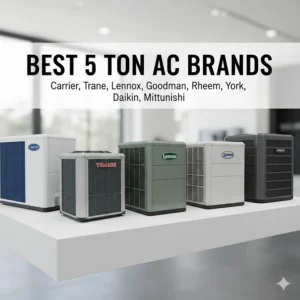
The best 5 ton air conditioner brand choices for commercial applications often depend on specific operational requirements. Office buildings with standard 8-10 foot ceilings and typical occupancy levels find that 5-ton units provide excellent zone control when properly sized. A single unit can effectively serve 2,500-3,000 square feet of office space, though this varies significantly based on factors like window area, internal heat loads from equipment, and building insulation quality.
Retail environments present unique challenges that make 5 ton AC unit for commercial settings particularly valuable. High ceilings, frequent door openings, and variable occupancy create cooling loads that fluctuate dramatically throughout the day. Variable-speed systems excel in these applications because they can ramp up during peak shopping hours and reduce output during slower periods, maintaining comfort while minimizing energy waste.
Professional testimonials from facility managers consistently highlight the importance of proper sizing and zoning. Sarah Martinez, facilities manager for a 25,000 square foot retail complex in Phoenix, reports that strategically placed 5-ton units with smart controls reduced their cooling costs by 35% compared to their previous oversized central system. The key was implementing zone-based controls that allowed different areas to maintain appropriate temperatures based on actual usage patterns.
Healthcare and Laboratory Applications
Medical facilities require precise environmental control that goes beyond simple temperature regulation. A 5.0 ton air conditioner in healthcare settings must maintain strict humidity levels, provide adequate air changes per hour, and operate reliably without interruption. The consequences of system failure in these environments can be severe, making redundancy and reliability paramount considerations.
Laboratory applications demand even more stringent environmental controls. Research facilities often require temperature stability within ±1°F and humidity control within ±5% relative humidity. Modern 5-ton systems with variable-speed technology and advanced controls can meet these requirements while providing energy efficiency that traditional constant-volume systems cannot match.
The pharmaceutical industry has embraced multi-zone 5-ton systems for cleanroom applications. These controlled environments require specific air pressure relationships and contamination control that properly designed HVAC systems can provide. Dr. Robert Chen, a pharmaceutical engineer, notes that newer 5-ton systems with HEPA filtration integration have revolutionized small-scale cleanroom design, making advanced manufacturing capabilities accessible to smaller companies.
Data Centers and Server Rooms
Modern data centers represent one of the most demanding applications for 5 ton air conditioner systems. The concentrated heat loads from servers create unique cooling challenges that require precise temperature control and exceptional reliability. Downtime in these facilities can cost thousands of dollars per minute, making system redundancy and performance monitoring essential.
The evolution toward edge computing has increased demand for smaller data center installations that benefit from 5-ton cooling solutions. These installations often require cooling densities of 200-400 watts per square foot, which pushes conventional systems to their limits. Advanced 5-ton units with enhanced heat rejection capabilities and precise controls have proven effective in these high-density applications.
Cloud service providers have developed innovative approaches to 5-ton system deployment in their smaller facilities. Amazon Web Services has documented significant energy savings by implementing variable-speed 5-ton units with economizer cycles in their edge locations. The ability to use outside air for cooling during cooler months can reduce mechanical cooling loads by up to 60% in appropriate climates.
Manufacturing and Industrial Applications
Manufacturing facilities present diverse cooling challenges that make 5-ton systems particularly versatile. Heat-generating processes, variable production schedules, and different zones with distinct requirements create complex cooling scenarios. The flexibility of modern 5-ton systems allows facilities to create customized solutions that address specific operational needs.
Automotive manufacturing has embraced 5-ton systems for paint booth climate control, where precise temperature and humidity control directly impacts product quality. The ability to maintain consistent conditions while accommodating the thermal loads from curing processes requires sophisticated control strategies that newer systems can provide. Ford Motor Company has reported improved paint quality and reduced energy costs after upgrading to variable-speed 5-ton systems in their smaller manufacturing cells.
Electronics manufacturing requires cleanroom-level environmental control in production areas. The semiconductor industry uses 5-ton systems for critical manufacturing processes where even small temperature variations can affect product yields. These applications often require custom controls integration and specialized filtration that demonstrate the adaptability of modern 5-ton platforms.
Regional and Cultural Considerations
Climate considerations significantly impact 5 ton air conditioner selection and operation. In the southeast region, any AC system that doesn’t meet SEER2 requirements cannot be installed on or after January 1, 2023, with residential central air systems requiring 14.3 SEER2 (15.0 SEER) minimum efficiency. These regional requirements reflect the increased cooling demands in warmer climates and drive technology adoption.
Cultural factors also influence system design and operation. European applications often prioritize energy efficiency over initial cost, leading to higher adoption rates of premium efficiency equipment. Asian markets frequently emphasize compact design and quiet operation, driving innovations in these areas that benefit global markets.
The hospitality industry has developed region-specific approaches to 5-ton system deployment. Resorts in tropical climates often require enhanced dehumidification capabilities, while mountain lodges need systems that can provide both heating and cooling efficiently. These diverse requirements have led to specialized system configurations that address specific regional needs.
Advanced Technical Analysis and Engineering Principles 🔬
Thermodynamic Principles and Refrigeration Cycles
Understanding the refrigeration cycle provides crucial insight into how 5 ton air conditioner systems achieve their impressive cooling capacity. The vapor-compression cycle that powers these systems involves four primary components: the compressor, condenser, expansion valve, and evaporator. In a 5-ton system, this cycle must handle the equivalent of 60,000 BTU/hour of heat transfer, requiring precise engineering and robust components.
Modern 5-ton systems utilize advanced compressor technologies that significantly improve efficiency and reliability. Scroll compressors have become the standard for most applications due to their smooth operation and excellent part-load efficiency. Variable-speed scroll compressors can modulate capacity from 25% to 100%, allowing systems to match cooling loads precisely and avoid the energy waste associated with frequent cycling.
The choice of refrigerant significantly impacts system performance and environmental considerations. New refrigerants like R-454B are more sustainable than the most recent refrigerant, R-410A, offering lower global warming potential while maintaining excellent thermodynamic properties. The transition to these newer refrigerants requires system design modifications but provides long-term environmental and performance benefits.
Heat exchanger design in 5-ton systems has evolved to maximize efficiency while minimizing physical size. Advanced fin designs and enhanced heat transfer surfaces can improve efficiency by 15-20% compared to conventional designs. Microchannel heat exchangers, while more expensive, offer superior performance in compact installations and provide better refrigerant distribution for optimal cooling capacity.
Energy Efficiency and Performance Metrics
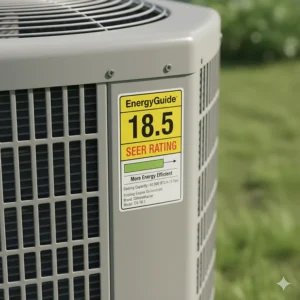
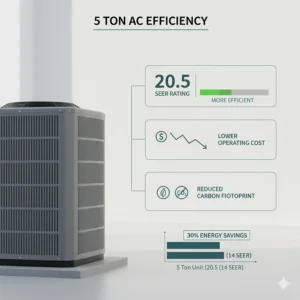
SEER2 ratings measure the total amount of heat removed from a home during a typical annual cooling season divided by the total electrical energy consumed during the same period. For 5-ton systems, SEER2 ratings typically range from 14.3 (minimum efficiency) to over 20 for premium units. Understanding these ratings helps predict operating costs and compare different system options effectively.
The relationship between SEER2 ratings and actual energy consumption isn’t linear, making detailed analysis important for proper system selection. A 5-ton air conditioner typically uses between 5,000 and 6,000 watts when running at full capacity, though this figure is influenced by the unit’s efficiency rating (SEER/EER), age, maintenance status, and environmental conditions. High-efficiency units can reduce power consumption by 30-40% compared to minimum-efficiency alternatives.
Part-load efficiency becomes particularly important in 5-ton applications because these systems rarely operate at full capacity for extended periods. Variable-speed systems excel in part-load conditions, often achieving efficiency levels 15-25% higher than their rated SEER2 values during typical operation. This real-world efficiency advantage makes the premium investment in variable-speed technology financially attractive in most applications.
Integrated Energy Efficiency Ratio (IEER) provides additional insight into commercial system performance. This metric evaluates efficiency across multiple operating conditions that better represent actual commercial operation. 5-ton commercial systems with high IEER ratings often provide superior energy performance despite having similar SEER2 ratings to other units.
Material Science and Durability Engineering
Component durability in 5-ton systems depends heavily on material selection and manufacturing quality. Compressor technology has advanced significantly, with modern scroll compressors featuring enhanced bearings, improved lubricants, and sophisticated protection controls that can extend operational life to 15-20 years under proper maintenance conditions.
Coil construction impacts both performance and longevity. Copper tube with aluminum fin construction remains standard for most applications, though enhanced fin coatings can improve corrosion resistance in coastal or industrial environments. Some manufacturers offer coil options with protective coatings that can extend life by 5-10 years in harsh conditions.
Control system reliability has become increasingly important as systems incorporate more sophisticated electronics. Modern 5-ton systems feature microprocessor-based controls that provide precise operation and diagnostic capabilities. These systems can detect and compensate for minor component degradation, maintaining efficiency and reliability throughout the system’s operational life.
Environmental considerations drive material selection toward more sustainable options. Lead-free soldering, recyclable components, and environmentally responsible manufacturing processes have become standard industry practices. These considerations don’t just benefit the environment; they often result in higher quality components that provide superior long-term performance.
Innovation Trends and Technological Advancement
Internet of Things (IoT) integration is transforming 5-ton system operation and maintenance. Smart sensors can monitor system performance in real-time, predicting maintenance needs and optimizing operation based on occupancy patterns and weather conditions. These capabilities can improve efficiency by 10-15% while reducing unexpected failures.
Artificial intelligence and machine learning are beginning to influence 5-ton system design and operation. Predictive controls can learn building usage patterns and pre-cool spaces before peak occupancy, reducing peak demand charges and improving comfort. Some systems can even adjust operation based on local weather forecasts and utility demand response programs.
Heat recovery technology is gaining adoption in 5-ton applications, particularly for commercial installations. Systems can capture waste heat from cooling operations and use it for domestic hot water heating or space heating in other zones. This integrated approach can improve overall system efficiency by 20-30% in appropriate applications.
Advanced filtration integration addresses growing concerns about indoor air quality. 5-ton systems can incorporate HEPA filtration, UV sterilization, and photocatalytic oxidation without significantly impacting system performance. These features have become particularly important in healthcare, educational, and commercial applications where air quality directly impacts occupant health and productivity.
Comprehensive Setup and Installation Guide 🔧
Pre-Installation Planning and Site Assessment
Successful 5 ton air conditioner installation begins with thorough site assessment and load calculation. Manual J load calculations remain the industry standard for determining appropriate system sizing, though advanced modeling software can provide more detailed analysis for complex applications. Proper sizing is critical because oversized systems waste energy and provide poor humidity control, while undersized systems cannot maintain comfort during peak conditions.
Electrical infrastructure assessment is particularly crucial for 5-ton installations. A 5 ton air conditioner typically requires a dedicated circuit with wiring sized to accommodate the maximum load, with common wire gauge sizes including 10 AWG copper wire suitable for up to 30 amp circuits. Voltage considerations become important for larger systems, with 230V single-phase or 208V three-phase options available depending on local electrical service.
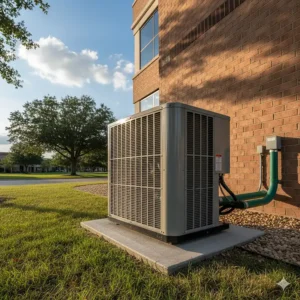
Structural considerations include adequate support for outdoor units, which can weigh 300-500 pounds when fully assembled. Concrete pads must be properly sized and level, with appropriate drainage to prevent water accumulation. Indoor unit locations require sufficient clearance for service access and proper air distribution to connected ductwork or zones.
Ductwork design significantly impacts system performance and efficiency. Properly sized ducts prevent excessive pressure drops that reduce efficiency and increase energy consumption. Duct leakage testing has become standard practice, with acceptable leakage rates typically below 6% of total system airflow. Sealing and insulation of ductwork can improve system efficiency by 10-20% in many installations.
Step-by-Step Installation Procedures
Professional installation of 5-ton systems requires specialized tools and expertise that go beyond typical residential installations. Refrigerant handling requires EPA certification, and electrical connections must comply with local codes and manufacturer specifications. The complexity of these systems makes professional installation essential for warranty coverage and proper operation.
The installation sequence typically begins with outdoor unit placement and electrical connections, followed by indoor unit installation and refrigerant line connections. Proper refrigerant charging requires precise measurement and testing to ensure optimal performance. Incorrect refrigerant levels can reduce efficiency by 10-20% and shorten component life significantly.
System commissioning involves comprehensive testing and adjustment to verify proper operation. This includes airflow measurement, refrigerant pressure testing, electrical verification, and control system programming. Proper commissioning can take 4-8 hours for complex systems but is essential for achieving rated performance and ensuring long-term reliability.
Documentation and training are often overlooked aspects of professional installation. Property owners should receive comprehensive system documentation, including operation manuals, warranty information, and maintenance schedules. Basic operation training helps ensure proper system use and can prevent many common operational problems.
Safety Considerations and Code Compliance
Electrical safety is paramount in 5-ton system installations due to the high current requirements and potential for serious injury from electrical faults. All electrical work must comply with National Electrical Code (NEC) requirements and local amendments. Ground fault protection and properly sized overcurrent protection devices are essential safety features.
Refrigerant safety has gained increased attention with the introduction of mildly flammable refrigerants like R-32. While these refrigerants offer environmental benefits, they require enhanced safety considerations during installation and service. Proper ventilation, leak detection, and technician training are essential elements of safe refrigerant handling.
Fire safety considerations include proper clearances from combustible materials and adequate ventilation for refrigerant safety. Some jurisdictions require special permits or inspections for larger systems, making early coordination with local authorities important for project success.
Environmental protection requirements include proper refrigerant recovery and disposal procedures. EPA regulations require certified technicians to recover refrigerants from existing systems and properly dispose of old equipment. Compliance with these requirements is not only legally required but also environmentally responsible.
Gradual System Startup and Optimization
Initial system startup should follow a graduated approach that allows components to reach optimal operating conditions gradually. This includes verifying proper refrigerant pressures, confirming electrical parameters, and testing all safety controls before placing the system in normal operation. Rush startup procedures can damage components and void warranty coverage.
Performance optimization often requires several weeks of operation and adjustment. Smart control systems can learn building characteristics and occupancy patterns, automatically adjusting operation for optimal efficiency and comfort. Manual systems may require periodic adjustment based on seasonal conditions and usage patterns.
User training and familiarization with system controls prevents many operational problems and ensures optimal performance. Building operators should understand basic system operation, maintenance requirements, and troubleshooting procedures. This knowledge can prevent many service calls and extend system life significantly.
Documentation of system performance during the first season provides valuable baseline data for future comparison. Energy consumption, maintenance requirements, and comfort complaints should be tracked to identify optimization opportunities and verify proper system operation.
5 Ton Air Conditioner Maintenance and Longevity Strategies 🛠️
Daily and Weekly Maintenance Protocols
Proper maintenance extends 5 ton air conditioner life significantly while maintaining peak efficiency and reliability. Daily visual inspections should include checking for unusual noises, ice formation, or refrigerant leaks. These simple checks can identify problems early, preventing minor issues from becoming major failures that require expensive repairs or premature replacement.
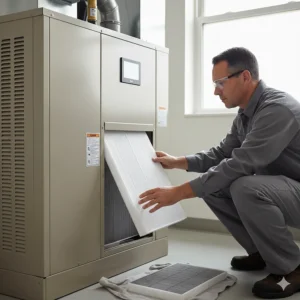
Weekly maintenance tasks include air filter inspection and cleaning or replacement as needed. Dirty filters can reduce system efficiency by 15-25% and increase energy consumption significantly. High-efficiency filters may require more frequent attention, particularly in dusty environments or applications with high air quality requirements.
Control system monitoring provides early warning of developing problems. Modern systems feature diagnostic capabilities that can identify component degradation before failure occurs. Weekly review of system alarms and performance data helps identify trends that require attention and enables proactive maintenance scheduling.
Outdoor unit inspection focuses on coil cleanliness, fan operation, and proper clearances. Debris accumulation around outdoor units can reduce efficiency and cause component damage. Maintaining proper clearances ensures adequate airflow and prevents recirculation of hot discharge air that reduces system capacity.
Monthly and Quarterly Service Requirements
Monthly maintenance includes more detailed system inspection and performance verification. Refrigerant pressure and temperature measurements help identify developing leaks or charging problems that affect efficiency and reliability. These measurements require professional expertise but provide valuable insight into system condition.
Electrical connection inspection prevents many common failures in 5-ton systems. High current levels can cause connection heating and deterioration that leads to system failure and potential safety hazards. Thermal imaging can identify developing electrical problems before they cause system damage or create safety risks.
Ductwork inspection identifies air leaks, insulation damage, and airflow restrictions that reduce system efficiency. Quarterly inspection helps identify problems early when repairs are less expensive and disruptive. Duct cleaning may be required annually or more frequently in dusty environments.
Control system calibration ensures accurate operation and optimal efficiency. Temperature sensors, pressure switches, and other control components can drift over time, affecting system performance. Professional calibration maintains proper operation and can improve efficiency by 5-10% in some cases.
Annual Professional Service and Inspection
Comprehensive annual service by qualified technicians is essential for maintaining warranty coverage and optimal performance. This service includes detailed system inspection, performance testing, and component replacement as needed. Professional service can identify problems that aren’t apparent during routine maintenance and prevent unexpected failures.
Refrigerant system testing includes leak detection, pressure testing, and refrigerant analysis. Small refrigerant leaks can reduce efficiency and cause compressor damage over time. Early detection and repair prevent more expensive problems and maintain optimal system performance.
Component replacement schedules help prevent unexpected failures and maintain system reliability. Items like contactors, capacitors, and fan belts have predictable service lives and should be replaced proactively. This approach reduces system downtime and prevents secondary damage from component failures.
Performance documentation provides valuable trend data for system optimization and replacement planning. Annual efficiency testing, energy consumption analysis, and comfort surveys help identify optimization opportunities and predict when system replacement may be cost-effective.
Troubleshooting Common Issues
System short cycling is a common problem that can indicate oversizing, refrigerant problems, or control issues. This condition wastes energy and reduces component life significantly. Proper diagnosis requires professional expertise but can often be resolved through control adjustments or minor component replacement.
Ice formation on indoor coils typically indicates airflow problems or refrigerant issues. Restricted airflow from dirty filters or blocked ducts is the most common cause and can be resolved through proper maintenance. Refrigerant problems require professional diagnosis and repair but can cause expensive compressor damage if not addressed promptly.
Unusual noises often indicate developing mechanical problems that require prompt attention. Bearing wear, loose components, or refrigerant flow problems can cause various noises that help identify specific problems. Early diagnosis and repair prevent more expensive damage and system failure.
High energy consumption can result from numerous factors including dirty coils, refrigerant problems, or control issues. Systematic diagnosis helps identify the root cause and guides appropriate corrective action. Energy monitoring can help track improvement after repairs and verify proper system operation.
Total Cost of Ownership Analysis
Operating costs for 5-ton systems vary significantly based on efficiency ratings, local electricity costs, and usage patterns. High-efficiency units with SEER2 ratings above 16 can reduce annual operating costs by 20-40% compared to minimum-efficiency alternatives. These savings often justify the higher initial investment in premium efficiency equipment within 3-5 years.
Maintenance costs typically represent 10-15% of total operating expenses for properly maintained systems. Preventive maintenance programs can reduce overall costs by preventing expensive failures and extending system life. Maintenance contracts often provide cost predictability and ensure proper service scheduling.
Replacement part availability and costs vary significantly between manufacturers and system types. Commercial-grade components often have better availability and longer support periods but may cost more initially. Considering long-term parts availability is important for systems expected to operate for 15-20 years.
Energy cost escalation affects long-term operating cost projections. Historical utility rate increases average 2-4% annually, making energy efficiency improvements more valuable over time. Systems with lower energy consumption provide better protection against future rate increases and environmental regulations.
Comparative Analysis: 5 Ton vs Alternative Solutions ⚖️
Capacity Comparison: 4-Ton vs 5-Ton vs 6-Ton Systems
System sizing decisions significantly impact performance, efficiency, and cost in commercial and large residential applications. 4-ton systems (48,000 BTU) work well for spaces up to 2,400 square feet, while 6-ton systems (72,000 BTU) can handle up to 3,600 square feet under typical conditions. The 5 ton air conditioner sits perfectly in the middle, providing 60,000 BTU capacity for 2,500-3,000 square foot applications.
Performance characteristics change significantly with system size. Larger systems typically offer better part-load efficiency due to enhanced controls and variable-speed technology. However, proper sizing remains critical because oversized systems waste energy through frequent cycling and provide poor humidity control in many climates.
Cost considerations include both initial investment and long-term operating expenses. While 6-ton systems cost 15-25% more than 5-ton units initially, the cost per BTU of capacity often decreases with larger systems. Operating costs depend primarily on efficiency ratings rather than system size, making proper sizing and efficiency selection crucial for minimizing total costs.
Installation complexity increases with system size due to higher electrical requirements, larger refrigerant lines, and increased physical dimensions. 6-ton systems often require three-phase electrical service that may not be available in residential applications, making 5-ton systems the practical maximum for many installations.
Multiple Smaller Units vs Single Large System
The choice between multiple 3-ton units versus a single 5-ton system involves complex trade-offs between efficiency, reliability, and cost. Multiple smaller units provide redundancy that prevents total system failure and allows zone-based control that can improve comfort and efficiency. However, they also require more maintenance and have higher installation costs per ton of capacity.
Energy efficiency comparisons favor larger single systems in most applications due to economies of scale in compressor technology and heat exchanger design. However, multiple smaller units can provide better part-load efficiency when only portions of a building require cooling. The optimal choice depends on specific application requirements and usage patterns.
Maintenance considerations often favor multiple smaller units because individual unit failures don’t compromise entire building comfort. Service and parts costs may be higher overall, but the ability to maintain partial cooling during equipment failures can be valuable in critical applications.
Installation flexibility strongly favors multiple smaller units in retrofit applications where structural or access limitations prevent large system installation. Smaller units can often be installed in phases, spreading costs over time and minimizing disruption to ongoing operations.
Traditional Split Systems vs Packaged Units
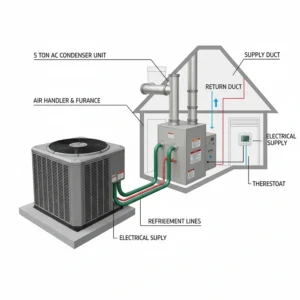
Split system configurations separate indoor and outdoor components, allowing more flexible installation and often providing better efficiency due to optimized component sizing. Packaged systems combine all components in a single outdoor unit, simplifying installation but potentially limiting efficiency and service access.
Installation cost differences depend on specific site conditions and requirements. Split systems require refrigerant line installation and electrical connections to both indoor and outdoor units. Packaged systems need only ductwork connections and single electrical service, often reducing installation complexity and cost.
Service accessibility favors split systems because indoor components are typically more accessible than packaged unit internals. However, packaged systems often feature better diagnostic capabilities and integrated controls that can simplify troubleshooting and repair.
Efficiency considerations generally favor split systems due to optimized component sizing and reduced refrigerant line lengths. However, high-quality packaged units can achieve similar efficiency levels while providing installation advantages in appropriate applications.
Heat Pump vs Air Conditioning Only Systems
Heat pump systems provide both heating and cooling capabilities, making them attractive for moderate climates where heating requirements are significant. Modern cold-climate heat pumps can provide effective heating down to -10°F or lower, expanding their application range significantly from earlier generations.
Energy efficiency for heating applications strongly favors heat pump systems over electric resistance heating. Even in cold conditions, heat pumps typically provide 2-3 times more heating per unit of electricity consumed compared to electric resistance systems. This advantage becomes more significant as electricity costs increase.
Installation complexity is similar between heat pump and cooling-only systems, with heat pumps requiring additional controls for heating operation and defrost cycles. Refrigerant line sizing may require modification to accommodate heating operation, but overall installation procedures are comparable.
Cost comparisons must consider both cooling and heating requirements. Heat pump systems typically cost 10-20% more initially than cooling-only systems but can provide significant savings compared to separate heating and cooling systems. The optimal choice depends on local climate conditions and energy costs.
Integration with Existing Building Systems
Building automation system integration capabilities vary significantly between manufacturers and system types. Modern 5-ton systems often feature BACnet or other standard communication protocols that enable integration with sophisticated building control systems. This integration can improve efficiency and provide centralized monitoring and control capabilities.
Electrical system compatibility requires careful consideration of available power capacity and distribution systems. 5-ton systems typically require dedicated 30-50 amp circuits at 230V single-phase or 208V three-phase power. Existing electrical systems may require upgrades to accommodate new equipment safely and reliably.
Ductwork integration affects both performance and installation costs. Existing ductwork may require modification or replacement to handle the airflow requirements of 5-ton systems. Proper duct sizing prevents efficiency losses and ensures adequate air distribution to conditioned spaces.
Controls integration allows coordination with existing HVAC systems, lighting controls, and occupancy sensors. Advanced systems can optimize operation based on occupancy patterns, weather conditions, and utility demand response programs. This integration can improve efficiency by 10-20% while enhancing occupant comfort.
Performance Comparison Table
| System Type | Cooling Capacity | SEER2 Rating | Initial Cost | Operating Cost/Year | Best Application |
|---|---|---|---|---|---|
| Trane XV20i | 60,000 BTU | 20.0 | $8,500-$12,000 | $890-$1,200 | Premium residential |
| YMGI Multi-Zone | 60,000 BTU | 21.0 | $4,200-$5,800 | $850-$1,100 | Flexible zoning |
| Goodman Package | 60,000 BTU | 14.0 | $3,200-$4,500 | $1,400-$1,800 | Budget commercial |
| Senville Heat Pump | 55,000 BTU | 16.0 | $3,800-$5,200 | $1,100-$1,400 | Year-round comfort |
| DAIKIN Commercial | 69,000 BTU | 15.5 | $6,800-$9,200 | $1,200-$1,600 | Commercial grade |
💬 Just one click – help others make better buying decisions too!😊
Case Studies and Real-World Success Stories 📊
Commercial Office Building Retrofit – Phoenix, Arizona
A 15,000 square foot office building in Phoenix replaced four aging 3-ton units with three strategically placed 5 ton air conditioner systems featuring 18 SEER2 efficiency ratings. The project, completed in spring 2024, demonstrates the benefits of right-sizing equipment while improving efficiency and reducing maintenance requirements.
Before Implementation:
- Four 12-year-old 3-ton units with 10 SEER ratings
- Annual cooling costs: $18,500
- Maintenance calls: 24 per year
- Tenant comfort complaints: 15-20 monthly during summer
After Implementation:
- Three new 5-ton units with 18 SEER2 ratings and variable speed technology
- Annual cooling costs: $11,200 (39% reduction)
- Maintenance calls: 6 per year
- Tenant comfort complaints: 1-2 monthly
The project required a $48,000 investment but achieved a 3.2-year payback period through energy savings and reduced maintenance costs. Advanced controls integration with the building automation system enabled occupancy-based cooling that further improved efficiency. The building owner reports that tenant satisfaction scores improved dramatically, contributing to higher lease renewal rates.
Key Success Factors:
- Proper load calculation and system sizing
- Integration with existing building automation systems
- Professional installation and commissioning
- Comprehensive maintenance program implementation
Healthcare Facility Critical Care Unit – Houston, Texas
A 45-bed critical care unit required precise environmental control with redundancy to ensure patient safety during equipment failures. The facility implemented five 5.0 ton air conditioner units with sophisticated controls and backup systems to maintain temperature within ±1°F and humidity within ±5% relative humidity.
Project Challenges:
- 24/7 operation requirements with no tolerance for failure
- Strict infection control protocols requiring positive pressure maintenance
- Variable patient loads affecting heat generation patterns
- Integration with existing emergency power systems
Solution Implementation:
- Five variable-speed 5-ton units with full redundancy (4+1 configuration)
- Advanced control system with automatic failover capabilities
- Enhanced filtration including HEPA and UV sterilization
- Comprehensive monitoring and alarm systems
Measured Results:
- Temperature stability: ±0.5°F during normal operation
- Humidity control: ±3% relative humidity
- Energy consumption: 22% lower than previous system
- Zero temperature-related equipment failures in 18 months of operation
The facility’s infection control specialist reports that improved air quality and environmental control have contributed to reduced hospital-acquired infection rates. The system’s reliability has eliminated emergency HVAC service calls, reducing operational disruptions and improving patient care quality.
Manufacturing Facility Clean Room – San Jose, California
A semiconductor components manufacturer required ISO Class 7 cleanroom conditions for circuit board assembly operations. The installation of six 5 ton AC unit for commercial cleanroom applications demonstrates the versatility and precision capabilities of modern systems in demanding industrial environments.
Environmental Requirements:
- Temperature: 70°F ±1°F
- Humidity: 45% ±5% relative humidity
- Air changes: 20 per hour minimum
- Particle control: ISO Class 7 standards
- Positive pressure maintenance: 0.05″ WC
System Design Features:
- Six 5-ton units with enhanced dehumidification capabilities
- Variable air volume controls for precise airflow management
- HEPA filtration integration with 99.97% efficiency
- Redundant systems preventing production interruptions
Production Impact Results:
- Product yield improvement: 12% over previous environmental control system
- Reduced contamination events: 85% decrease in particle-related defects
- Energy efficiency: 30% improvement over constant-volume system
- Maintenance downtime: Reduced from 8 hours monthly to 2 hours monthly
The manufacturer’s quality control manager emphasizes that consistent environmental conditions have been crucial for maintaining product quality and meeting customer specifications. The system’s ability to maintain precise conditions while adapting to varying production schedules has improved overall operational efficiency.
Educational Facility Renovation – Atlanta, Georgia
A 35,000 square foot middle school underwent comprehensive HVAC renovation, replacing an aging central system with seven 5-ton units providing zone-based control for different areas including classrooms, gymnasium, cafeteria, and administrative offices.
Educational Environment Challenges:
- Variable occupancy from 50-800 people depending on activities
- Different cooling requirements for various spaces (gymnasium vs classrooms)
- Limited maintenance budget requiring reliable, efficient equipment
- Indoor air quality concerns affecting student health and learning
Implementation Strategy:
- Zone-based system design with individual 5-ton units for different areas
- Smart controls with occupancy sensors and CO2 monitoring
- Enhanced filtration for improved indoor air quality
- Sound-dampening features for classroom environments
Educational Outcomes:
- Student attendance improvement: 3% increase attributed to better indoor air quality
- Teacher satisfaction scores: 25% improvement in comfort ratings
- Energy costs: 35% reduction compared to previous central system
- Maintenance costs: 40% reduction due to improved equipment reliability
The school district’s facilities director reports that the new system’s reliability has eliminated class disruptions from HVAC problems. The improved indoor air quality has contributed to better student concentration and learning outcomes, justifying the investment beyond simple energy savings.
Hospitality Industry Resort Application – Miami, Florida
A 120-room resort hotel implemented a distributed cooling strategy using twenty-four 5-ton systems to provide individual zone control for different building areas while maintaining guest comfort and operational efficiency in the challenging South Florida climate.
Hospitality Industry Requirements:
- Guest comfort expectations: precise temperature control
- 24/7 operation with minimal maintenance disruptions
- Energy efficiency to control operating costs
- Quiet operation for guest satisfaction
System Configuration:
- Twenty-four 5-ton heat pump systems with individual zone controls
- Smart room controls with mobile app integration
- Energy recovery ventilation for improved efficiency
- Preventive maintenance program with remote monitoring
Business Impact Results:
- Guest satisfaction scores: 18% improvement in comfort ratings
- Energy costs per room: 28% reduction vs. previous central system
- Maintenance-related guest disruptions: 90% reduction
- System reliability: 99.8% uptime in first two years
The resort’s general manager notes that the system’s reliability and efficiency have contributed significantly to guest satisfaction and operational profitability. The ability to control individual zones allows optimal comfort while minimizing energy waste in unoccupied areas.
Future Trends and Market Evolution 🔮
Emerging Technologies and Innovation Directions
Artificial intelligence integration is transforming 5 ton air conditioner operation and maintenance through predictive analytics and automated optimization. Machine learning algorithms can analyze building usage patterns, weather data, and system performance to optimize operation automatically. These systems can achieve 15-20% energy savings while improving comfort through precise control that adapts to changing conditions continuously.
Quantum cooling technology, while still in development, promises revolutionary improvements in efficiency and performance. Early research suggests potential efficiency improvements of 30-50% over conventional vapor-compression systems. While commercial availability remains several years away, this technology could fundamentally change HVAC system design and operation.
Advanced materials development focuses on improving heat transfer efficiency and reducing environmental impact. Graphene-enhanced heat exchangers show promise for improving capacity while reducing size and weight. Nano-materials in refrigerant formulations could provide better thermodynamic properties while addressing environmental concerns.
Internet of Things (IoT) integration enables unprecedented system monitoring and control capabilities. Smart sensors throughout buildings can provide real-time feedback on occupancy, air quality, and comfort conditions. This data enables precise system control that optimizes energy consumption while maintaining ideal environmental conditions. Edge computing integration allows local processing that improves response times and reduces dependence on cloud connectivity.
Market Trends and Consumer Behavior Evolution
Sustainability consciousness is driving increased demand for high-efficiency systems and environmentally responsible refrigerants. New SEER2 efficiency standards effective January 1, 2023, require higher minimum efficiency levels that eliminate the least efficient equipment from the market. These regulations reflect growing environmental awareness and drive continued technology advancement.
Electrification trends, particularly in commercial applications, are increasing demand for heat pump systems that can replace gas heating while providing cooling. This trend is accelerated by utility incentives, carbon reduction goals, and improved cold-climate heat pump performance. The best 5 ton air conditioner brand manufacturers are responding with enhanced heat pump offerings that maintain efficiency in challenging conditions.
Remote work trends have changed commercial building usage patterns, creating opportunities for more sophisticated control strategies. Buildings with variable occupancy benefit from systems that can adapt to changing conditions automatically. Demand response programs allow utilities to temporarily reduce building cooling loads during peak periods, providing economic benefits while supporting grid stability.
Health and wellness concerns have elevated indoor air quality as a primary consideration in system selection. Advanced filtration, UV sterilization, and air quality monitoring have become standard features rather than optional upgrades. These features add system complexity but provide important benefits for occupant health and productivity.
Sustainability and Environmental Considerations
Refrigerant evolution continues toward lower global warming potential (GWP) options that reduce environmental impact. R-454B and other next-generation refrigerants offer significant environmental benefits while maintaining performance characteristics. The transition to these refrigerants requires system design modifications but provides long-term environmental advantages.
Circular economy principles are influencing system design toward improved recyclability and component reuse. Manufacturers are developing take-back programs that recover materials from old equipment for use in new systems. This approach reduces waste while providing economic benefits through material recovery.
Carbon footprint reduction initiatives drive adoption of high-efficiency systems and renewable energy integration. Solar-powered cooling systems using photovoltaic arrays to power 5-ton systems can achieve net-zero energy operation in appropriate climates. Battery storage integration allows load shifting that reduces peak demand and provides backup power capabilities.
Life cycle assessment (LCA) methodology helps evaluate total environmental impact including manufacturing, operation, and disposal phases. This comprehensive approach identifies optimization opportunities throughout the system lifecycle and guides development of more sustainable products and practices.
Personalization and Customization Possibilities
Individual comfort preferences vary significantly between occupants, creating opportunities for personalized environmental control. Smart systems can learn individual preferences and automatically adjust conditions based on occupancy detection and historical data. This personalization can improve comfort while reducing energy consumption through precise control.
Adaptive comfort standards recognize that occupant comfort zones can vary based on activity levels, clothing, and personal preferences. Systems that can accommodate these variations provide better comfort while potentially reducing energy consumption through wider acceptable temperature ranges.
Workplace wellness trends emphasize the connection between environmental conditions and productivity. Advanced systems can optimize temperature, humidity, and air quality for different activities and times of day. Research suggests that optimal environmental conditions can improve productivity by 10-15%, justifying investment in sophisticated control systems.
Building-as-a-service models are emerging where HVAC systems are provided as services rather than purchased equipment. This approach transfers operational and maintenance responsibilities to service providers while providing predictable costs for building owners. These models can drive adoption of high-efficiency equipment through improved economics and professional management.
Industry Predictions and Upcoming Developments
System integration will continue advancing toward fully connected building ecosystems where HVAC systems communicate with lighting, security, and other building systems. This integration enables optimization strategies that consider all building systems together, potentially improving overall efficiency by 20-30% compared to independent system operation.
Predictive maintenance will become standard practice through improved sensors and analytics capabilities. Systems will predict component failures before they occur, scheduling maintenance proactively to prevent unexpected downtime. This approach can reduce maintenance costs while improving system reliability and performance.
Energy storage integration will enable thermal energy storage that shifts cooling loads to off-peak periods. Ice storage systems can produce ice during low-demand periods and use it for cooling during peak hours, reducing utility costs and supporting grid stability. Battery integration provides backup power and demand management capabilities.
Modular system design will provide improved flexibility and serviceability through standardized components that can be easily replaced or upgraded. This approach reduces maintenance costs and enables system upgrades without complete replacement, extending system life and improving long-term value.
Investment and Purchase Decision Framework 💰
Cost-Benefit Analysis Methodology
Comprehensive financial analysis for 5 ton air conditioner investments requires consideration of multiple cost factors beyond initial purchase price. Total cost of ownership includes equipment costs, installation expenses, operating costs, maintenance expenses, and eventual replacement or disposal costs. This holistic approach provides accurate investment evaluation that considers all relevant financial impacts.
Energy cost projections significantly impact long-term financial analysis due to the substantial operating costs of 5-ton systems. A 5-ton air conditioner typically uses between 5,000 and 6,000 watts when running at full capacity, resulting in substantial annual electricity consumption. Historical utility rate increases average 2-4% annually, making energy efficiency improvements more valuable over time.
Return on investment (ROI) calculations for high-efficiency systems often show favorable payback periods when properly analyzed. Premium efficiency equipment typically costs 20-30% more initially but can reduce operating costs by 25-40% through improved efficiency. Simple payback periods of 3-5 years are common, with net present value calculations showing positive returns over 10-15 year evaluation periods.
Financing options can significantly impact project economics and cash flow considerations. Equipment financing, utility rebate programs, and tax incentives can reduce effective project costs while spreading payments over time. These programs often make high-efficiency equipment more accessible and improve overall project economics.
Implementation Strategy Development
Phased implementation strategies allow spreading costs over time while providing immediate benefits from improved equipment. Priority should be given to replacing the oldest or least efficient equipment first, maximizing early returns while building experience with new technology. This approach also allows refinement of specifications and procedures for subsequent phases.
Timing considerations affect both equipment costs and installation scheduling. Off-season installation often provides better contractor availability and potentially lower costs, though emergency replacements may not allow optimal timing. Planning replacement before equipment failure prevents emergency situations that limit options and increase costs.
Contractor selection significantly impacts project success and long-term satisfaction. Qualified contractors with 5-ton system experience, proper licensing, and good references are essential for proper installation and warranty coverage. Investment in quality installation often pays dividends through improved performance and reduced maintenance requirements.
System specifications should balance performance requirements with cost considerations while ensuring adequate capacity for intended applications. Over-specifying equipment wastes money, while under-specifying can result in poor performance and comfort problems. Professional load calculations and system design help optimize specifications for specific applications.
Budget Planning and Financing Strategies
Equipment costs vary significantly based on efficiency ratings, features, and manufacturer selections. Budget-friendly options like the Goodman GPC1460H41 start around $3,200, while premium systems like the Trane XV20i can exceed $12,000. Understanding these cost ranges helps establish realistic budgets and evaluate options appropriately.
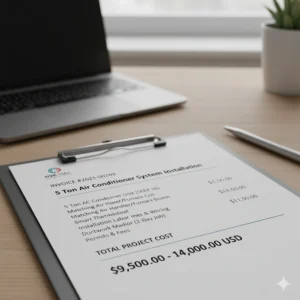
Installation costs typically represent 30-50% of total project costs and vary based on complexity, site conditions, and local labor rates. Simple package unit installations may cost $2,000-$4,000, while complex split system installations with extensive ductwork modifications can exceed $8,000. Obtaining detailed installation quotes prevents budget surprises and enables accurate project planning.
Utility rebate programs can provide substantial cost offsets for high-efficiency equipment. Many utilities offer rebates of $500-$2,000 for qualifying systems, significantly improving project economics. These programs often have specific requirements and application procedures that must be completed before installation begins.
Tax incentive programs at federal, state, and local levels can provide additional financial benefits for qualifying equipment. Federal tax credits, accelerated depreciation, and local incentive programs can reduce effective equipment costs by 20-30% in many cases. Professional tax advice helps maximize available benefits while ensuring compliance with program requirements.
Decision Criteria and Evaluation Matrices
Performance requirements should drive system selection based on specific application needs rather than simply choosing the least expensive option. Critical factors include cooling capacity, efficiency ratings, reliability requirements, noise considerations, and control sophistication. Weighting these factors based on application priorities helps guide appropriate system selection.
Lifecycle cost analysis provides the most accurate basis for equipment selection when properly conducted. This analysis considers all costs over the expected system life, including energy costs, maintenance expenses, and replacement considerations. Systems with higher initial costs often provide better lifecycle value through improved efficiency and reliability.
Vendor evaluation should consider manufacturer reputation, warranty coverage, parts availability, and service support quality. Established manufacturers with comprehensive support networks often provide better long-term value despite potentially higher initial costs. Local service availability is particularly important for minimizing downtime and service costs.
Risk assessment helps identify potential problems and mitigation strategies before they occur. Factors to consider include equipment reliability, service availability, parts costs, and technological obsolescence. Understanding these risks enables appropriate system selection and contingency planning that prevents expensive problems.
Measuring Success Metrics and Performance Indicators
Energy consumption monitoring provides quantitative measurement of system performance and efficiency improvements. Smart meters and energy monitoring systems can track consumption patterns and identify optimization opportunities. Baseline measurements before system installation enable accurate assessment of improvement achieved through equipment upgrades.
Comfort measurement through temperature monitoring and occupant surveys helps evaluate system performance from a user satisfaction perspective. Consistent temperatures, adequate humidity control, and acceptable noise levels are key indicators of proper system operation. Regular surveys help identify problems early and guide system optimization efforts.
Maintenance cost tracking provides insight into system reliability and long-term value. Preventive maintenance costs should be relatively predictable, while unexpected repair costs may indicate problems requiring attention. Comparing actual costs to projected values helps evaluate vendor performance and system reliability.
Financial performance measurement compares actual costs and savings to projected values, enabling evaluation of investment success. Regular analysis helps identify optimization opportunities and guides future investment decisions. Documentation of financial performance also supports justification for similar investments in other applications.
Quick Comparison Tables
Efficiency and Performance Comparison
| Model | SEER2 Rating | BTU Capacity | Annual Energy Use | Noise Level | Best For |
|---|---|---|---|---|---|
| Trane XV20i | 20.0 | 60,000 | 3,000 kWh | 69 dB | Premium residential |
| YMGI Multi-Zone | 21.0 | 60,000 | 2,857 kWh | 55 dB | Flexible applications |
| Goodman Package | 14.0 | 60,000 | 4,286 kWh | 76 dB | Budget commercial |
| Senville Heat Pump | 16.0 | 55,000 | 3,438 kWh | 65 dB | Year-round comfort |
Cost Analysis by Application Type
| Application | Equipment Range | Installation Range | Annual Operating | 10-Year Total Cost |
|---|---|---|---|---|
| Small Commercial | $4,500-$8,000 | $3,000-$5,000 | $1,200-$1,800 | $25,000-$35,000 |
| Large Residential | $3,500-$12,000 | $2,500-$6,000 | $900-$1,600 | $21,000-$34,000 |
| Industrial | $5,000-$10,000 | $4,000-$8,000 | $1,100-$1,700 | $26,000-$35,000 |
| Healthcare | $6,000-$15,000 | $5,000-$10,000 | $1,000-$1,500 | $28,000-$40,000 |
Features and Benefits Matrix
| Feature | Trane XV20i | YMGI Multi-Zone | Goodman Package | Senville Heat Pump |
|---|---|---|---|---|
| Variable Speed | ✅ | ✅ | ❌ | ✅ |
| Smart Controls | ✅ | ✅ | ❌ | ✅ |
| Heat Pump Option | ❌ | ✅ | ❌ | ✅ |
| Multi-Zone Capable | ❌ | ✅ | ❌ | ❌ |
| Commercial Grade | ✅ | ✅ | ✅ | ❌ |
| 10+ Year Warranty | ✅ | ❌ | ✅ | ✅ |
💬 Just one click – help others make better buying decisions too!😊
Frequently Asked Questions ❓
❓ How much electricity does a 5 ton air conditioner use per hour?
❓ What size building can a 5 ton air conditioner cool effectively?
❓ Can I install a 5 ton air conditioner myself or do I need a professional?
❓ How often should I replace the air filter in my 5 ton air conditioner?
❓ What's the average lifespan of a quality 5 ton air conditioner system?
🛒 Ready to Upgrade Your Cooling Power?
These top-rated 5-ton systems represent the best combination of performance, efficiency, and value available today. Whether you need budget-friendly reliability or premium features, there’s a perfect match for your specific requirements. Click any highlighted product above to check current Amazon pricing and availability! ⚡
Recommended for You
- 7 Best 3.5 Ton Air Conditioner Units That Will Transform Your Home Cooling in 2025
- Ultimate 3.0 Ton Air Conditioner Guide: 7 Best Units for Maximum Comfort in 2025
- 7 Best 2.5 Ton Air Conditioner Units That Deliver Powerful Cooling in 2025
Disclaimer: This article contains affiliate links. If you purchase products through these links, we may earn a small commission at no additional cost to you.
✨ Found this helpful? Share it with your friends! 💬🤗
